

Rewarding ads transform player frustration into monetization opportunities when implemented correctly. Rovio proved this at scale with Angry Birds 2, where carefully placed rewarded video ads generate over 60% of total ad revenue while maintaining player satisfaction scores above industry benchmarks. The secret lies in understanding the psychological contract: players willingly watch advertisements in exchange for tangible in-game benefits that feel fair, timely, and valuable.
For Unity developers building mid-core multiplayer games in 2026, rewarding ads represent the most player-friendly monetization method available. Unlike interstitials that interrupt gameplay or banner ads that clutter interfaces, rewarded videos give players control. They choose when to engage, what to receive, and whether the exchange feels worthwhile. This opt-in model creates positive sentiment rather than resentment, a critical distinction when building long-term player retention.
The mechanics seem straightforward: show a 15-30 second video, grant currency or power-ups, repeat. But Rovio’s success reveals deeper complexity. Placement timing matters enormously. Reward value must scale with player progression. Integration points need careful UX consideration. And metrics extend far beyond simple eCPM calculations to include engagement rates, session length impact, and conversion effects on IAP revenue.
This article dissects Rovio’s rewarding ads strategy, examines Unity integration specifics for 2026, and outlines implementation frameworks for multiplayer games. You’ll discover where to place ad opportunities for maximum voluntary engagement, how to structure rewards that feel generous without cannibalizing purchases, and which metrics actually predict long-term monetization health. The goal: actionable guidance that respects your players while strengthening your revenue foundation.
What Makes Rewarding Ads Different from Traditional In-Game Advertising
Rewarding ads fundamentally shift the power dynamic between game developers and players. Unlike traditional advertising that treats players as passive viewers, rewarding ads establish an explicit value exchange: players voluntarily watch for rewards in return for tangible in-game benefits. This opt-in model transforms advertising from an interruption into a strategic player decision.
Traditional banner ads and interstitials operate on interruption. They hijack screen space, pop up between matches without warning, and actively disrupt gameplay flow. Players develop banner blindness or simply resent the intrusion. The advertiser gets impressions, but engagement remains minimal and the player experience suffers. Interstitials are worse, forcing full-screen ads at arbitrary moments that break immersion entirely.
Rewarded video ads flip this relationship. The player sees an opportunity, evaluates whether the reward justifies 15-30 seconds of their time, and makes a conscious choice. This agency matters psychologically. When players control the interaction, they don’t experience it as manipulation or disruption. Instead, they view it as a fair transaction where both parties benefit.
| Dimension | Traditional Ads | Rewarding Ads |
|---|---|---|
| Player Control | Forced viewing, no choice | Completely optional, player-initiated |
| Engagement Rate | Low (banner blindness common) | High (85-95% completion when opted-in) |
| Revenue Per Impression | $0.50-2.00 eCPM | $10-40 eCPM |
| Player Satisfaction | Negative (seen as intrusive) | Positive (perceived as generous option) |
The psychological principle underlying rewarding ads is self-determination theory. Players need to feel autonomous in their decisions. When that autonomy is respected, even commercial interactions become acceptable, sometimes welcome. A player who chooses to watch an ad for extra lives doesn’t feel exploited because they weighed the trade-off and decided it was worth it. That single element of choice transforms the entire dynamic, turning what could be friction into a feature players actively appreciate.
Rovio’s Blueprint: How Angry Birds Perfected the Rewarded Ad Model
Rovio transformed their Angry Birds franchise into a case study for rewarding ads by treating them as gameplay features rather than monetization afterthoughts. Their approach centers on positioning: they present ads at moments when players face clear obstacles and immediately understand how the reward solves their specific problem.
In Angry Birds 2, Rovio places rewarded video opportunities when players run out of destructive spells during a challenging level. The player sees their remaining birds, recognizes they’re short of completing the structure, and receives a prompt to watch an ad for an extra spell card. This timing works because the player has already invested effort in the level and can visualize exactly how the reward changes their outcome. The ad becomes a tactical decision, not an interruption.
Angry Birds Dream Blast uses a slightly different implementation for its bubble-popping puzzle mechanics. When players exhaust their moves without clearing the required bubbles, they can watch an ad to receive five additional moves. Rovio calibrated this carefully: five moves provide a genuine chance to complete the level without guaranteeing success, which preserves challenge and prevents the ad from replacing skill entirely. The company also limits this option to once per level, maintaining scarcity and preventing over-reliance.
The reward types Rovio offers vary by game mode but follow consistent principles. Players receive consumable resources that expire with the current attempt (extra moves, additional birds, spell cards), not permanent upgrades or premium currency that might cannibalize in-app purchases. This distinction protects the core economy while giving immediate, tangible value. In competitive modes within Angry Birds 2, Rovio offers entry tickets to special events or tournaments, connecting ad engagement directly to progression systems players already care about.
Frequency management represents perhaps Rovio’s most critical achievement. They cap rewarded ad availability, typically offering two to four opportunities per gameplay session depending on session length and failure points. This scarcity accomplishes two goals: it prevents ad fatigue and maintains the perception of rewards as valuable rather than infinite. Players who consistently complete levels without failure rarely encounter ad prompts, while struggling players see them as helpful tools rather than mandatory gates.
Rovio also refined their presentation UI to emphasize choice. The prompt clearly shows what the player receives, requires an explicit opt-in action, and always includes a visible decline option with no penalty messaging. This transparency builds trust and reinforces that rewarding ads serve players rather than exploit them.

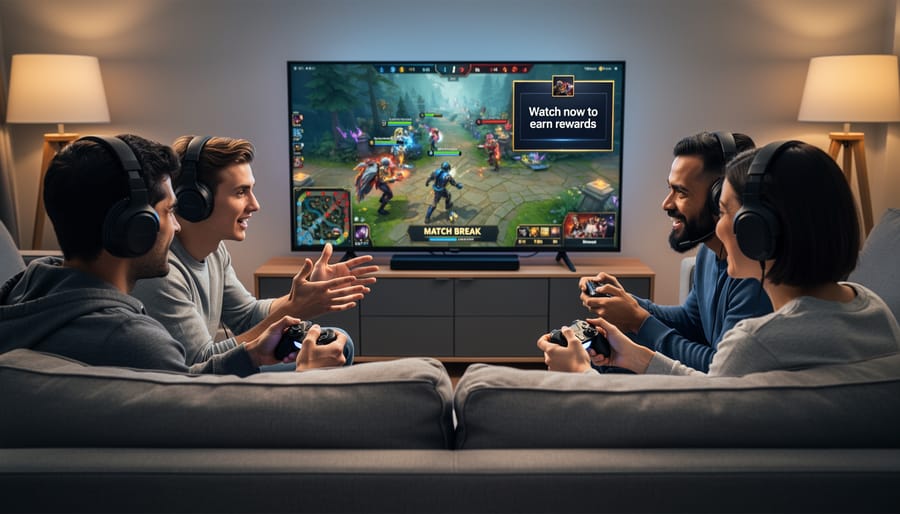
Strategic Placement Points for Rewarding Ads in Mid-Core Multiplayer Games
Post-Match and Between-Session Opportunities
Post-match screens and lobby waiting periods represent prime territory for rewarding ads in competitive games. After a match concludes, players are already in a natural pause, reviewing results and deciding whether to queue again. This break in action removes the friction of interrupting gameplay, while the player’s engagement remains high. Offering bonus XP for the next match, extra currency to spend on loadout improvements, or temporary boosts that activate in the following session creates immediate value tied to continued play.
Between-session moments work particularly well because players mentally prepare for what’s next rather than dwelling on disruption. A reward that carries forward, such as double currency for the next three matches or a single-use power-up available in the upcoming game, leverages anticipation. This timing demands careful multiplayer execution since server-validated rewards must sync properly before the next session begins. Calibrate cooldowns so ads don’t appear after every single match, which trains players to expect constant offers and dilutes perceived value. Limit availability to once every 60-90 minutes to maintain the reward’s special status.
Failure Recovery and Continue Mechanics
Failure states in multiplayer games create high-value moments for rewarding ads because players are emotionally invested in the outcome. When a match goes poorly or a competitive run ends just short of a milestone, players face a choice: accept the loss or spend premium currency to continue. Rewarding ads provide a third option that costs nothing from the player’s wallet.
The mechanic works best when the continue genuinely matters. In a ranked match where one more round could secure victory, or during a tournament run where defeat means starting over, players willingly watch a 30-second ad to get another chance. Rovio implemented this effectively in Angry Birds 2’s tournament modes, where extra birds offered through rewarded video let players extend their attempts without dipping into gem reserves.
The key is limiting frequency without making the option feel punitive. Offering one ad-based continue per session feels generous; unlimited continues risk trivializing difficulty and hurting retention. Consider a cooldown system where players can watch an ad for revival once every hour, or limit it to specific competitive modes rather than casual play.
Match revival mechanics require server-side validation to prevent exploitation. When a player watches an ad for a continue in a multiplayer context, verify completion before granting the reward and resuming the match state. This prevents players from backing out mid-ad or using network manipulation to claim rewards fraudulently.
The psychology matters as much as the implementation. Frame the option positively as “Get Another Chance” rather than “Avoid Losing,” and make the button visually distinct from premium currency spends so players understand they’re choosing between different value exchanges.
Designing Rewards That Feel Valuable Without Breaking Game Economy
The core challenge with rewarding ads lies in making them attractive enough to watch without undermining your paying customers or destabilizing competitive balance. Players need to feel the reward is worth thirty seconds of their time, but if that reward equals what someone else paid five dollars for, you’ve just cannibalized your in-app purchase revenue.
Start by categorizing rewards by their economic impact. Premium currency sits at the highest risk level because it directly competes with your primary monetization. If you offer it through rewarding ads, limit quantities severely, perhaps 5-10% of what a paying player could buy for a dollar. Rovio typically gates premium currency behind daily limits, ensuring free players get a taste while paying players maintain clear advantage through volume.
Power-ups and consumables work better for rewarding ads in competitive contexts, but require careful tuning. Give temporary boosts rather than permanent upgrades. A player who watches an ad might receive one bonus shield for their next match, while your store sells bundles of ten. The watching player gets immediate tactical value without invalidating the purchase decision for committed players. Time-gate these rewards, one power-up per ad, maximum three ads per day, to prevent grinding.
Time skips present an interesting middle ground. In multiplayer games with upgrade timers or energy systems, letting players skip thirty minutes of wait time for an ad feels generous without breaking anything. The math matters here: if your average player session involves two hours of natural wait time, allowing them to skip an hour total through ads still leaves monetization space for impatient players willing to pay.
Cosmetic rewards pose the lowest economic risk and often generate the highest engagement in mid-core multiplayer titles. Players love expressing identity, and exclusive ad-earned cosmetics create status without affecting gameplay balance. Rovio has used this extensively, offering special character skins or avatar frames through ad engagement. Create visual distinction, “ad-earned” cosmetics should look appealing but different from premium ones, maintaining separate value propositions.
Loot boxes through rewarding ads need transparent odds and lower-tier contents than paid equivalents. If your premium loot box guarantees one rare item, your ad-based box might offer common items with a small chance at rare drops. This preserves the gambling appeal that drives engagement while keeping paid boxes clearly superior.
In competitive multiplayer environments, never give match-affecting rewards immediately before PvP encounters. A player who watches three ads right before ranked play and gains temporary advantages creates legitimate grievances. Instead, route ad rewards into general progression systems or offer them during preparation phases where all players have equal opportunity to engage with ads.
The golden rule: every rewarding ad should feel like a small gift, not a substitute for opening your wallet.

Technical Implementation in Unity: Integrating Rewarded Ad SDKs
Getting rewarding ads running in Unity requires deliberate architectural decisions, not just dropping an SDK into your codebase. The technical path you choose shapes how smoothly ads integrate with your game loop, especially when multiplayer synchronization and server-side validation enter the picture.
Most Unity developers start with one of three major networks: Unity Ads (now part of ironSource), Google AdMob, or AppLovin. Unity Ads offers native integration and streamlined implementation for Unity projects, while AdMob provides access to Google’s extensive advertiser demand. However, relying on a single network caps your revenue potential. Mediation platforms like LevelPlay (ironSource), MAX (AppLovin), or Google Ad Manager let you auction inventory across multiple networks simultaneously, typically boosting eCPM by 20-40% compared to single-network implementations.
Here’s the integration sequence that minimizes debugging headaches:
- Select your mediation platform first, then add network adapters rather than integrating networks directly. This architecture decision saves you from rewriting reward callbacks when you add networks later.
- Configure mediation in the platform’s web dashboard, setting up waterfalls and test device IDs before touching Unity. You’ll validate SDK communication against known configurations rather than guessing at backend setup issues.
- Implement the reward callback with defensive programming. Check ad availability before showing UI prompts, handle both successful completion and user dismissal, and wrap reward delivery in try-catch blocks that log failures without crashing the session.
- Build server-side validation into your reward pipeline for any competitive multiplayer context. Send the ad completion event to your game server with a transaction ID, validate it against the ad network’s server-to-server callback, then grant the reward. Client-side-only validation invites exploitation.
- Integrate analytics tracking that captures opt-in rates, completion rates, and technical failures separately. The mediation platform provides basic metrics, but you need game-context data showing which placement points perform and where players abandon ads.
The mid-core team setup matters here because ad integration touches multiple disciplines. Your client engineers handle SDK integration and UI flows, while server engineers implement validation and reward delivery. Without clear ownership boundaries in a two-team structure reward validation logic ends up split across client and server in ways that create race conditions and edge cases.
For multiplayer games, timestamp synchronization prevents exploits. When a player watches an ad during a match, your server needs to verify the completion timestamp falls within the actual match duration. Store ad view events with server time on reward request, not client-reported time that players can manipulate.
Testing presents unique challenges because ad networks don’t fill 100% of requests, and test ads behave differently than production inventory. Build a debug mode that simulates ad callbacks without network calls, letting QA verify reward logic independently from ad availability. Before launch, run limited production tests with real ads in soft-launch regions to catch platform-specific issues Android and iOS handle video playback differently, and some older devices struggle with video ad performance in demanding 3D games.
Metrics That Matter: Measuring Rewarded Ad Performance
Tracking the right metrics separates successful rewarding ad implementations from those that drain player goodwill without generating meaningful revenue. Start with opt-in rate, the percentage of players who choose to watch an ad when offered. Healthy opt-in rates in mid-core games typically range from 15% to 40%, depending on reward value and placement timing. If your opt-in rate falls below 10%, your rewards likely aren’t compelling enough or you’re presenting ads at inconvenient moments.
Completion rate measures how many players who start an ad actually watch it through to receive the reward. Aim for completion rates above 90%. Lower numbers often indicate technical issues, excessively long ad creatives, or misleading reward descriptions that disappoint players mid-view.
Effective cost per mille (eCPM) represents the revenue generated per thousand ad impressions. In 2026, competitive eCPMs for rewarded video ads range from $10 to $50, varying significantly by geography and player demographics. North American audiences typically command higher eCPMs than other regions.
Ad revenue per daily active user (ARPDAU) provides the clearest picture of your rewarding ads’ contribution to overall monetization. Calculate this by dividing total daily ad revenue by your DAU count. For shipping multiplayer titles, ARPDAU from rewarding ads might range from $0.02 to $0.15, complementing rather than replacing IAP revenue.
The critical balancing act involves monitoring IAP cannibalization. Compare your average revenue per paying user (ARPPU) and conversion rate to paid before and after implementing rewarding ads. If ARPPU drops more than 5-10% without a corresponding increase in total revenue, you’re giving away too much value through ads. The goal is expanding your monetization base by generating revenue from non-payers while maintaining your paying players’ spending habits. Track retention metrics closely too, rewarding ads should maintain or improve Day 1 and Day 7 retention by enhancing the player experience, not degrade it through overexposure.
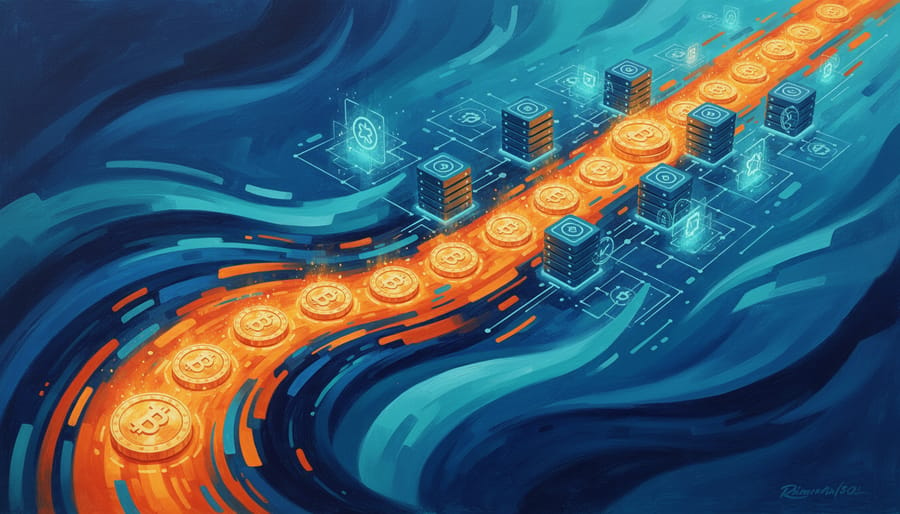
Common Pitfalls and How to Avoid Them
Even successful studios stumble when rolling out rewarding ads. The difference between implementations that generate revenue and those that tank retention often comes down to avoiding a handful of predictable mistakes.
The most damaging error is excessive frequency. Bombarding players with ad opportunities every few minutes destroys the perception of choice and turns your optional system into a mandatory grind. Rovio learned this early: their data showed that offering more than three rewarding ad opportunities per session in Angry Birds 2 actually decreased overall ad revenue because players felt harassed and engagement dropped. Set clear cooldowns between ad offers and respect the “no thanks” decision without pestering.
Unclear value propositions kill opt-in rates. If players can’t immediately grasp what they’ll receive for watching an ad, they won’t engage. Generic prompts like “Watch for a reward!” fail where specific offers like “Watch to gain 50 gems (2 minutes of progress)” succeed. Display the exact reward value before the player commits, and make sure that reward aligns with their current needs. Offering extra lives when the player already has ten accomplishes nothing.
Technical failures that prevent reward delivery are among the worst mid-core game risks for rewarding ads. Players tolerate many issues, but watching a 30-second ad and receiving nothing in return destroys trust permanently. Common culprits include:
- Poor network handling that fails to verify ad completion before closing the ad unit
- Missing server-side validation allowing client-side reward manipulation
- Race conditions in multiplayer contexts where session state changes during the ad
- Regional ad network gaps leaving players with no available ads to watch
- Ignoring player feedback about specific ad creatives that crash or freeze
Build robust error handling, always grant the reward if there’s any ambiguity, and monitor your support tickets for patterns indicating systemic problems.
Finally, burying the optional nature of rewarding ads in poor UI creates a manipulative experience. Players should never feel tricked into watching an ad. Use clear, dismissible prompts with prominent “No Thanks” options. The close button shouldn’t be a tiny X in the corner that appears only after five seconds. Respect the player’s time and autonomy, and they’ll choose to engage on their own terms.
Regional Considerations for International Audiences
Rewarding ads perform differently across international markets, and a one-size-fits-all approach rarely works. Players in Europe, North America, and other regions bring distinct expectations about advertising, respond differently to reward structures, and are governed by different legal frameworks.
Start with compliance. Europe requires GDPR consent mechanisms, meaning you must obtain explicit permission before collecting identifiers for targeted advertising. The United States and Canada have state-level regulations like CCPA and other privacy laws that demand clear opt-out mechanisms. Build your consent management platform to adapt based on player location, and remember that non-compliance can result in substantial fines. Your ad SDK should handle most of this automatically, but you need to configure it correctly for each territory.
Cultural attitudes toward advertising vary significantly. European players generally prefer fewer, higher-value rewarding ads and show less tolerance for frequent ad placement. North American audiences typically accept higher ad frequency if rewards feel substantial. Asian markets often show the highest engagement rates with rewarding ads, while players in some European countries view any advertising as intrusive regardless of rewards offered.
Ad fill rates fluctuate by region and directly impact your revenue potential. North America typically delivers the highest eCPMs and most consistent fill rates. Western European countries follow closely, while Eastern European, Latin American, and some Asian markets often have lower fill rates and CPMs. Test your mediation waterfall separately for each major region to optimize revenue.
Localize reward messaging beyond simple translation. A “free bonus” might resonate in the USA, while “optional reward” performs better in Germany. Adjust reward values based on regional purchasing power and existing monetization patterns to maintain consistent player value across markets.
Rovio’s success with rewarding ads in the Angry Birds franchise proves a fundamental truth: players don’t object to advertising when it respects their autonomy and delivers genuine value. The difference between intrusive monetization and effective rewarding ads comes down to three core principles: player choice, reward calibration, and relentless testing.
Mid-core multiplayer games built in Unity present unique opportunities for rewarding ads precisely because competitive and progression-focused players actively seek advantages that feel earned rather than purchased. When you position ads at natural gameplay breaks, tie rewards to upcoming challenges, and maintain clear opt-in messaging, you create a monetization layer that coexists with rather than competes against your IAP strategy.
The technical implementation through Unity’s ecosystem makes integration straightforward, but the real work lies in ongoing optimization. Monitor your opt-in rates, completion percentages, and retention metrics weekly. A/B test reward structures, placement timing, and frequency caps relentlessly. Regional performance will vary significantly, so segment your analysis across Europe, North America, and your other core markets.
Done correctly, rewarding ads generate sustainable revenue while improving player satisfaction metrics. They give players without spending capacity a path to progression and provide spenders with low-friction boosts between purchases. Moore Games implements these systems within Unity-based multiplayer projects, balancing technical integration with the economic modeling that protects your game’s long-term health.