
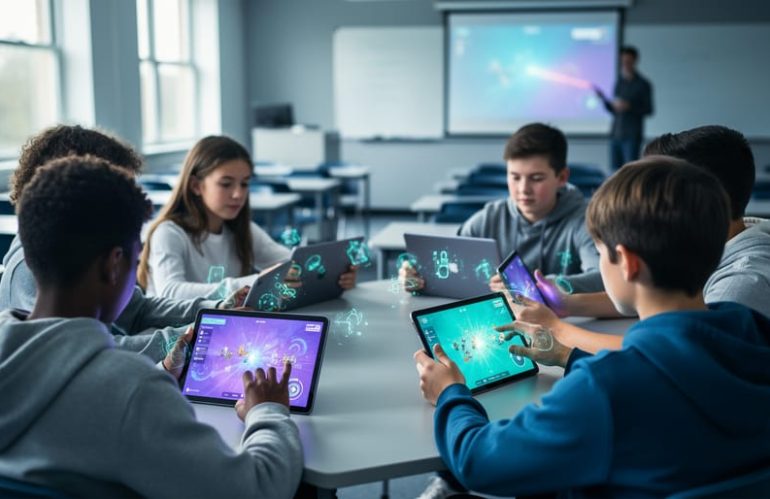
Educational games for eighth graders succeed when they balance subject mastery with social interaction, competition, and genuine player agency. At this developmental stage, students are transitioning from concrete to abstract thinking while simultaneously navigating complex social hierarchies, which means effective games must respect their growing cognitive sophistication without patronizing them. The most successful implementations use multiplayer frameworks built in Unity that allow for both collaborative problem-solving and competitive elements, mirroring the peer dynamics that define this age group.
Eighth graders represent a particularly valuable target demographic because they’re old enough to engage with complex game mechanics yet still receptive to structured learning environments. Unlike younger students who respond well to overt reward systems, this age group demands subtlety. They see through gamification that feels manipulative but will invest hundreds of hours in experiences that respect their intelligence and offer meaningful choices.
The technical challenge lies in creating mid-core experiences that bridge entertainment and education without compromising either. Multiplayer components are especially critical here, not as a supplementary feature but as the core engagement mechanism. Eighth graders learn better when competing with or supporting peers in real-time, which requires server architecture that can handle classroom-scale concurrent sessions while maintaining the performance standards they expect from commercial games.
For developers and educators looking to integrate these tools effectively, understanding the specific cognitive and social characteristics of 13-to-14-year-olds transforms game design from a generic educational exercise into targeted, impactful experiences that actually improve learning outcomes. This requires rethinking both the technical implementation and the pedagogical approach simultaneously.
The Eighth Grade Sweet Spot: Why This Age Group Needs Different Game Design

Eighth graders occupy a developmental territory that demands careful navigation from game designers. At 13 and 14, these students have moved beyond the concrete operational thinking of elementary years and entered a phase of abstract thinking in adolescence where they can handle complex systems, hypothetical scenarios, and nuanced problem-solving. They’re not children anymore, yet they’re not quite ready for adult-level complexity either, a reality that fundamentally shapes every development decision.
The social landscape becomes paramount during this stage. Peer validation drives engagement more powerfully than parental or teacher approval ever could. Design choices that worked for fifth graders, bright colors, simple characters, obvious praise, now trigger immediate rejection. Eighth graders scrutinize whether a game makes them look cool or childish in front of classmates, which means aesthetics, narrative tone, and social features carry weight beyond mere decoration.
Their digital fluency presents both opportunity and challenge. These students grew up with smartphones and have logged thousands of hours across gaming platforms. They instantly recognize lazy mechanics, dated interfaces, or patronizing tutorial systems. They compare every educational experience to Fortnite, Minecraft, and Roblox, games built by large teams with significant budgets. Meeting their baseline expectations for responsiveness, visual polish, and intuitive controls isn’t optional.
This combination of cognitive maturity, social hypersensitivity, and technical sophistication creates a narrow target. Games must respect their intelligence while channeling their competitive energy, integrate seamlessly with their existing digital habits, and never feel like dressed-up worksheets. When developers understand these developmental realities from the outset, they build experiences that eighth graders actually want to engage with rather than endure.
Core Mechanics That Drive Learning Without Feeling Like School
Multiplayer as a Learning Accelerator

Eighth graders learn faster when they can test their understanding against peers in structured multiplayer environments. The social dynamics of this age group make collaborative problem-solving and friendly competition natural motivators that traditional single-player educational software often misses.
2-team multiplayer formats work particularly well because they create clear social structures where students take on distinct roles, strategist, calculator, researcher, communicator, and rely on each other’s strengths to succeed. When one student explains a concept to a teammate to advance the group, that peer-teaching moment often cements understanding better than passive review.
Competitive ranking systems tap into the achievement orientation of 13-14 year olds without requiring direct confrontation. Leaderboards that update based on collaborative problem sets rather than individual performance encourage students to contribute meaningfully without isolating weaker performers. The key is designing systems where ranking reflects collective progress, not just raw speed or accuracy.
Team-based challenges allow eighth graders to experience authentic interdependence, the realization that their contribution matters to others creates accountability that solitary assignments rarely achieve. Unity’s networking capabilities make these multiplayer frameworks technically feasible across different classroom or remote learning environments, enabling real-time collaboration without demanding complex server infrastructure from schools.
The multiplayer approach transforms educational content from something students endure individually into a shared experience where learning becomes the means to a socially rewarding end. When designed with care, these systems create communities of practice where eighth graders naturally mentor, debate, and refine their understanding together.
Balancing Challenge and Achievement
Eighth graders live in a narrow performance corridor. Make content too simple and they’ll dismiss your game as “for babies.” Pitch it too hard and they’ll quit rather than admit frustration. The solution lies in balancing skill and challenge to create flow states where players lose track of time because they’re operating at the edge of their abilities.
This balance shifts constantly. A physics puzzle that challenged students in week one becomes routine by week three. Static difficulty curves fail because learning happens at different rates. You need systems that respond to individual progress without making adjustments obvious.
Unity’s real-time analytics provide the data layer for adaptive difficulty. Track completion times, retry counts, and success patterns per student. When a player breezes through three consecutive challenges in under target time, the next iteration introduces additional constraints or removes helpful indicators. Conversely, if someone fails the same objective twice, subtle assistance appears, a hint system that activates after 90 seconds of inactivity, or temporary power-ups that don’t feel like handouts.
The key is making these adjustments feel like natural game progression rather than pedagogical scaffolding. Frame increased difficulty as unlocking “expert mode” or accessing “advanced techniques.” Present assistance as discovering hidden game mechanics. Eighth graders will engage with challenging content if it feels like leveling up their gaming skills, not compensating for academic weakness.
Build your analytics dashboard to flag students operating outside flow parameters. Teachers can then intervene with targeted support or enrichment, but the game itself handles moment-to-moment calibration automatically, keeping every player in their optimal challenge zone.
Subject Integration Strategies for Maximum Impact
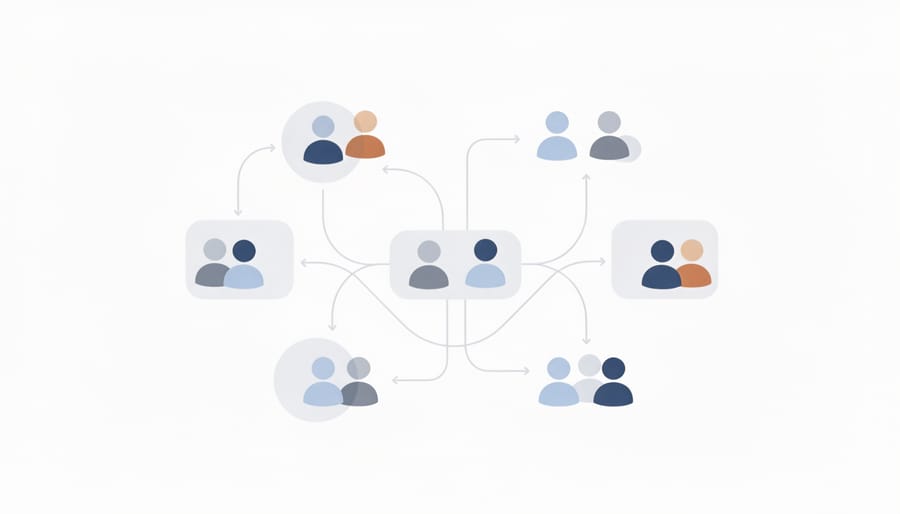
Successful subject integration requires treating academic content as a core gameplay pillar rather than an afterthought bolted onto existing mechanics. Eighth graders possess enough domain knowledge to appreciate authentic applications but remain skeptical of games that feel like disguised worksheets. The key is embedding concepts where they create genuine strategic value or narrative tension.
STEM subjects naturally align with problem-solving gameplay. Physics simulations can drive puzzle mechanics where students manipulate variables to achieve objectives, adjusting trajectory angles, calculating momentum transfers, or optimizing chemical reactions under constraints. Algebra becomes the language of resource management systems where eighth graders balance equations to unlock upgrades or solve increasingly complex production chains. Biology thrives in ecosystem simulations where students manage interconnected systems, making decisions about predator-prey relationships, genetic variation, or environmental factors that cascade through food webs.
Literacy and critical thinking demand different approaches. Narrative-driven games can embed vocabulary naturally through dialogue systems where word choice affects outcomes, or detective mysteries requiring students to analyze textual evidence for logical contradictions. Social studies content works best when students inhabit roles that force them to grapple with complex decisions, economic simulations where they manage historical civilizations facing resource scarcity, or political strategy games exploring how constitutional principles constrain or enable governmental power.
| Subject Area | Effective Game Genres | Example Mechanics | Learning Outcomes |
|---|---|---|---|
| Mathematics | Strategy, Resource Management | Production chains requiring ratio optimization, spatial puzzles with geometric constraints | Applied problem-solving, equation manipulation, pattern recognition |
| Science | Simulation, Sandbox | Ecosystem balancing, physics-based challenges, experimental design with controlled variables | Systems thinking, hypothesis testing, scientific method application |
| Literacy | Narrative Adventure, RPG | Dialogue trees with consequence systems, evidence-based reasoning puzzles | Critical reading, argument analysis, contextual vocabulary |
| Social Studies | Management, Historical Strategy | Civilization building with historical constraints, civic decision simulations | Historical causation, civic reasoning, cultural perspective-taking |
Real-world relevance matters intensely to this age group. Frame challenges around scenarios eighth graders find meaningful, designing sustainable cities that balance growth and environmental impact, managing social media platforms that must balance free expression and safety, or solving engineering problems that connect to visible infrastructure in their communities. When integrating this kind of depth into your educational content workflow prioritize authenticity over coverage. Three deeply integrated concepts that students can manipulate and explore beat a dozen superficial references that only require recall.
Technical Foundations: Building Educational Games That Scale
Unity Architecture for Educational Contexts
Unity’s modular architecture solves a fundamental challenge in educational game development: creating content that adapts to different learning paces and classroom needs. Scene management becomes your primary organizational tool when building for eighth graders who progress at varying speeds through material.
Structure your project with discrete scene-based learning modules rather than monolithic level progression. Each scene can represent a self-contained concept, a specific math principle, a historical scenario, or a scientific experiment, allowing teachers to assign targeted experiences based on individual student needs. Unity’s additive scene loading lets you layer assessment overlays or multiplayer components onto these core modules without restructuring your entire development workflow.
For tracking learning metrics, Unity Analytics provides event-based data collection that captures meaningful interactions without performance overhead. Define custom events that map to educational objectives: problem-solving attempts, collaboration instances, concept mastery indicators. This granular data feeds dashboards teachers actually use, showing which students grasp concepts immediately and which need intervention.
Networking architecture deserves particular attention for classroom contexts. Unity’s Netcode for GameObjects handles both local LAN scenarios, common in school computer labs with restrictive firewalls, and cloud-based solutions for remote learning. Build with connection resilience in mind; eighth graders will attempt simultaneous logins, unreliable home internet, and unexpected disconnections.
The Addressables system streamlines content updates post-deployment. When curriculum changes or you identify areas needing refinement, push new learning modules without requiring full application updates, critical when dealing with school IT departments and approval processes. This separation between code and content means educators can receive fresh material throughout the school year while your core systems remain stable.
Data Privacy and Compliance Considerations
Building games for eighth graders means navigating a complex regulatory landscape where a single misstep can derail an entire project. The players in your educational game are minors, and data protection laws treat them as a protected class requiring heightened safeguards.
COPPA (Children’s Online Privacy Protection Act) governs how you collect, use, and store data from users under 13 in the United States. While eighth graders typically fall just outside this threshold at 13-14 years old, many schools serve mixed-age populations, and COPPA-compliant design is often the baseline expectation. You need verifiable parental consent mechanisms before collecting personal information, clear privacy policies written for both parents and children, and strict limits on what data you gather.
FERPA (Family Educational Rights and Privacy Act) adds another layer when your game operates within educational institutions. Student educational records receive federal protection, meaning any gameplay data tied to academic performance, assessment results, or personally identifiable information falls under FERPA oversight. Your data handling agreements with schools must specify how information is stored, who can access it, and under what circumstances data can be shared.
Privacy-first architecture means building your Unity project with data protection embedded from the start. Design your database schema to minimize personally identifiable information collection. Implement robust encryption for data at rest and in transit. Create clear data retention policies with automated deletion schedules. Build granular permission systems so educators can control what student information flows through your game and where it goes.
The technical decisions you make during development have legal consequences. Anonymous analytics that track aggregate learning patterns are far safer than individual performance tracking tied to student names. Pseudonymization strategies, where student identifiers are separated from learning data, offer a middle ground that preserves educational utility while reducing privacy risk. Your Unity integration should default to the most privacy-protective settings, requiring explicit configuration to collect additional data rather than gathering everything and asking permission later.
Assessment Integration Without Breaking Immersion
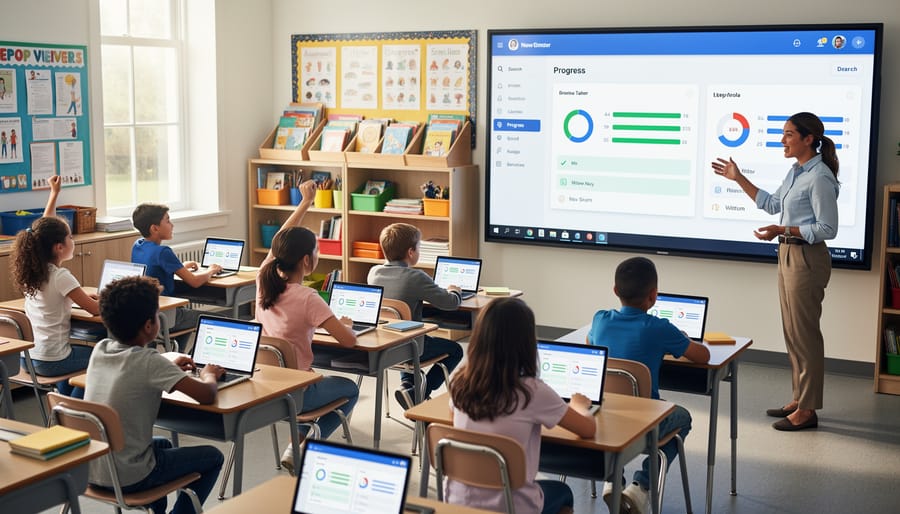
The most effective educational games for eighth graders measure learning without students realizing they’re being tested. Traditional assessment methods, quizzes that pause gameplay, explicit test questions, or obvious evaluation screens, break immersion and remind players they’re in an educational environment, triggering the exact resistance this age group exhibits toward “school stuff.”
Stealth assessment integrates evaluation directly into core mechanics. When students solve a physics puzzle to progress through a level, the game simultaneously captures data about their understanding of force, momentum, and energy transfer. If players consistently choose diplomatic solutions in a historical simulation, that reveals comprehension of conflict resolution strategies without administering a multiple-choice test. The assessment becomes invisible because it is the gameplay itself.
Unity’s analytics frameworks allow developers to track granular player actions, decision patterns, problem-solving approaches, time-to-solution, and collaborative behaviors, then translate these into meaningful educational metrics. A science game might monitor how students manipulate variables in an experiment simulation, recording whether they test hypotheses systematically or randomly. This data reveals conceptual understanding far more accurately than asking students to explain their reasoning in written form.
Educator-facing dashboards must translate this gameplay data into actionable insights without requiring teachers to interpret raw statistics. Effective reporting shows which learning objectives individual students have mastered, where they struggle, and how they compare to grade-level benchmarks. Teachers need to see “struggling with algebraic reasoning” rather than “failed level 7 three times.”
The reporting layer should respect classroom reality. Daily granular updates overwhelm teachers; weekly summaries with flagged concerns work better. Including contextual information, like whether a student attempted a challenge multiple times before succeeding, helps educators distinguish perseverance from confusion.
Well-designed assessment systems strengthen rather than interrupt the game experience. When eighth graders receive immediate feedback through natural consequences (a bridge collapses because calculations were wrong) rather than error messages, learning accelerates and engagement remains intact.
Avoiding Common Pitfalls in Educational Game Development
The gap between a successful educational game and one that eighth graders immediately dismiss often comes down to a few critical missteps. Developers who’ve worked primarily on games for younger students frequently carry assumptions that simply don’t translate to this age group, and the results are predictably ignored by the target audience.
The most damaging mistake is infantilization. Eighth graders can spot condescension instantly. Overly cheerful characters, simplistic narratives that talk down to players, or reward systems built around cartoon stickers signal that the game wasn’t made with them in mind. This age group craves sophistication and relevance. They’ll engage with challenging content if it respects their intelligence, but they’ll abandon anything that feels like it was designed for elementary school students wearing a thin disguise.
Another common failure: letting educational objectives dominate the experience. When learning content interrupts gameplay rather than driving it, you’ve built a digital worksheet, not a game. The quiz-then-reward pattern, solve math problems to unlock the next level, creates a transactional relationship that feels artificial. Effective integration means the educational content is the game mechanic itself, not a barrier between the player and fun.
Pros
- Embedding learning naturally within core mechanics creates intrinsic motivation and sustained engagement.
- Respecting eighth graders’ sophistication through complex narratives and mature themes builds trust and investment.
- Multiplayer elements that leverage peer dynamics transform learning into social experiences that feel authentic.
- Iterative testing with actual eighth graders reveals mismatches between developer assumptions and student realities.
Cons
- Treating eighth graders like younger students through simplistic interfaces or patronizing content guarantees immediate rejection.
- Front-loading educational objectives over gameplay mechanics creates the dreaded “worksheet with graphics” experience.
- Underestimating digital literacy leads to tutorials and explanations that insult players’ existing gaming knowledge.
- Disconnecting game themes from eighth graders’ actual interests, social dynamics, identity, real-world relevance, results in low engagement.
Developers also consistently underestimate eighth graders’ digital fluency. This generation has grown up with sophisticated gaming experiences across platforms. Clunky interfaces, slow pacing, or overly explanatory tutorials suggest the developers don’t understand who they’re building for. These students navigate complex multiplayer environments and master intricate game systems in their free time, your educational game needs to match that bar, not lower it.
Finally, theme disconnection kills engagement. Games centered on topics that feel irrelevant to teenage concerns, without clear bridges to issues they care about like social justice, identity, technology’s impact, or future possibilities, struggle to gain traction. Eighth graders want to see themselves and their world reflected in meaningful ways, not abstract lessons divorced from their lived experience.
Collaborative Development: Working with Educators and Stakeholders
Building educational games for eighth graders demands input from multiple perspectives, developers alone can’t predict what truly works in a classroom. Successful projects require structured collaboration between development teams, educators, and the target audience from day one rather than treating stakeholder input as an afterthought.
Start by establishing a core advisory group of experienced eighth-grade teachers who understand curriculum standards and student behaviour patterns. These educators identify which learning objectives genuinely matter and which game mechanics will resonate versus falling flat with 13-14 year olds. Schedule regular check-ins during pre-production and alpha phases, not just at the end when fundamental changes become costly.
Student focus groups provide reality checks that adults miss. Eighth graders quickly expose patronizing content, confusing interfaces, or mechanics that feel like busywork dressed as play. Run structured playtesting sessions with mixed ability levels, capturing both observational data (where players struggle or disengage) and direct feedback through post-session interviews. These sessions reveal whether your progression systems feel rewarding or arbitrary, whether your difficulty curves match actual student capabilities.
Iterative development cycles work best when you integrate education experts throughout rather than building in isolation. Share prototypes early, even when rough. A curriculum specialist can confirm whether your chemistry puzzle actually teaches molecular bonding or just tests pattern recognition. When feedback conflicts, teachers wanting more assessment data versus players wanting fewer interruptions, transparent discussion leads to solutions like background analytics rather than forced quiz screens.
Documentation matters too. Maintain shared design documents that translate game systems into educational outcomes, helping educators advocate for your project within their institutions while keeping development focused on measurable learning goals alongside engagement metrics.
Creating educational games for eighth graders isn’t just about adding quiz questions to a game engine. It demands a deep understanding of adolescent development, technical expertise in platforms like Unity, and genuine collaboration between developers and educators. The developmental sweet spot of 13-14 year olds requires games that respect their growing sophistication while acknowledging their ongoing need for structure and guidance.
The most successful educational games emerge when developers treat this work as a specialized discipline rather than a simplified version of commercial game development. Unity’s multiplayer capabilities, robust analytics, and cross-platform architecture provide the technical foundation, but the real magic happens when gaming expertise meets educational insight. Developers who engage with teachers throughout the design process, incorporate learning science into their mechanics, and test iteratively with actual eighth graders consistently produce experiences that genuinely transform learning outcomes.
Educational game development for this age group represents an opportunity to create experiences that teenagers actually want to play while delivering measurable academic results, a rare combination that requires commitment to both craft and collaboration.