
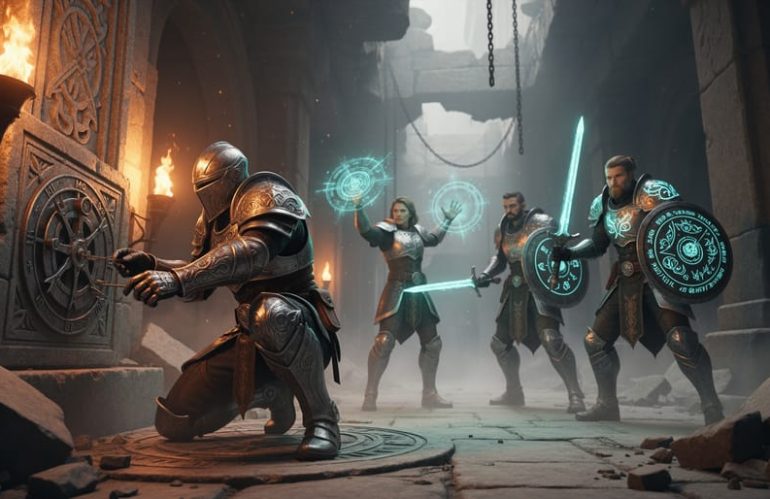
Dungeons & Dragons Online is a free-to-play MMORPG set in the Eberron campaign setting that translates tabletop D&D mechanics into real-time combat and dungeon exploration. If you’re wondering whether DDO still deserves your attention in 2026, the answer is yes. The game continues to receive active updates (Update 81.1.1 dropped this week, following 81.1 on August 5th) and offers a genuinely free experience that respects both your wallet and your time, though the optional VIP subscription at $14.99 monthly unlocks the full breadth of content.
What sets DDO apart from typical MMORPGs is its commitment to authentic D&D rules. Character creation mirrors the tabletop experience with meaningful class choices, skill checks that actually matter during quests, and combat that rewards tactical thinking over button-mashing. You’ll navigate traps using your Disable Device skill, persuade NPCs through Diplomacy checks, and coordinate with your party to overcome instanced dungeons designed around the classic D&D adventure structure.
For developers studying MMORPG design, DDO presents a compelling case study in adapting pen-and-paper systems to multiplayer frameworks. The game demonstrates how complex rule sets can drive engagement when implemented with fidelity, particularly in its approach to character progression and party-based gameplay. While many mid-core multiplayer games chase action-heavy mechanics, DDO proves there’s still an audience hungry for strategic depth and narrative-driven dungeon crawling.
What Makes DDO Different from Other MMORPGs
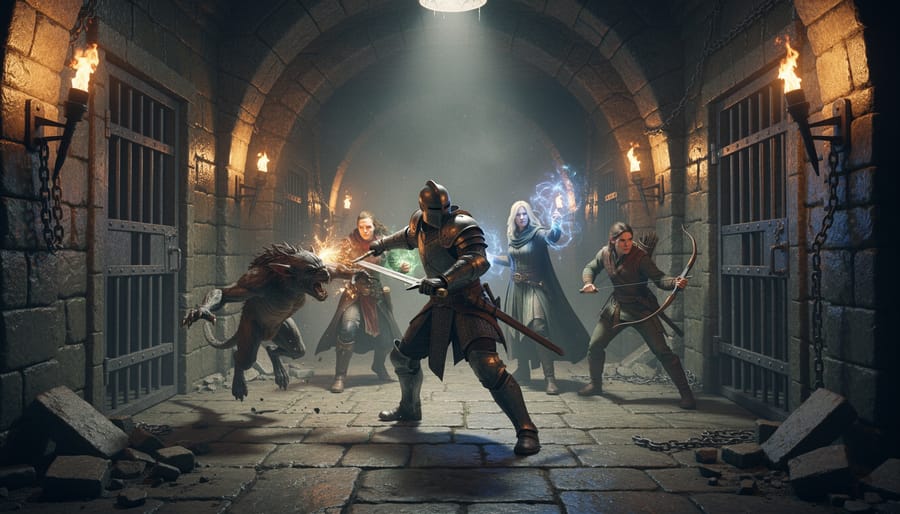
Most MMORPGs follow a familiar pattern: auto-targeting combat, level-locked zones, and predefined class paths. Dungeons & Dragons Online breaks that mold by faithfully adapting tabletop D&D mechanics into a multiplayer environment, creating an experience that feels genuinely different.
The game blends rules from D&D 3.5 Edition with elements from 5th Edition, retaining the complexity tabletop players expect. Your character sheet isn’t just window dressing, it determines your saving throws, skill checks, and combat modifiers exactly as it would in a tabletop session. When you attempt to pick a lock or disarm a trap, the game rolls virtual dice against your skill bonuses, not a simple progress bar.
Combat demands active participation rather than rotation memorization. You control movement, blocking, and timing directly. Enemies won’t politely wait while you select abilities. Dodge a charging minotaur at the wrong moment, and you’ll take the full hit. This action-oriented approach rewards player skill alongside character stats, bridging the gap between tabletop strategy and real-time execution.
DDO structures content around instanced dungeons rather than open-world grinding. Each quest functions as a self-contained adventure with objectives, traps, puzzles, and a dungeon master’s narration guiding your party. These aren’t simple “kill ten rats” tasks, you’ll navigate complex environments, make meaningful choices, and encounter optional challenges that alter rewards.
Character customization goes far beyond choosing a class at creation. Multiclassing lets you combine abilities from different classes without restriction, creating hybrid builds impossible in most MMOs. Want a wizard who wears heavy armor and wields a greatsword? The system allows it, just like the tabletop game.
For players seeking ultimate challenge, permadeath modes exist where a single death ends your character permanently. These hardcore options mirror the high-stakes tension of tabletop campaigns where careful planning and teamwork become survival necessities, not mere optimization strategies.
Getting Started: Character Creation and Customization
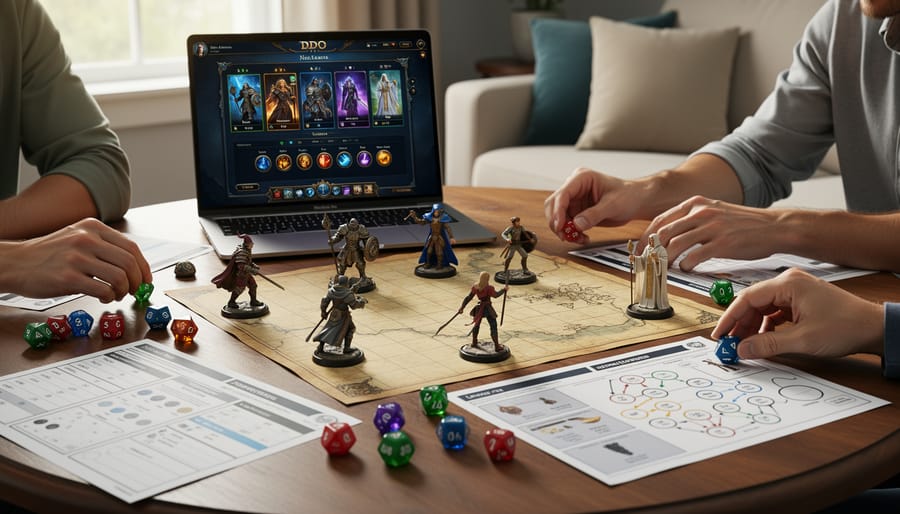
Creating your first character in DDO is where the game’s tabletop heritage becomes immediately apparent. Unlike class-locked MMORPGs that restrict you to predefined archetypes, DDO offers genuine freedom to shape a character that reflects your playstyle and fantasy. The character creator provides 15+ playable races including humans, elves, dwarves, warforged (living constructs), and dragonborn, each with distinct racial abilities and stat bonuses that meaningfully affect gameplay.
Class selection forms the foundation of your character’s identity, with over a dozen base classes ranging from traditional fighters and wizards to artificers and warlocks. Each class draws from D&D’s 3.5 and 5th edition rulesets, bringing familiar mechanics like spell slots, rage abilities, and sneak attack damage into real-time gameplay. What truly sets DDO apart is unrestricted multiclassing at any level. You can start as a rogue, add wizard levels for spellcasting, then branch into monk for combat mobility, a flexibility that mirrors tabletop role playing game design philosophy rather than typical MMORPG constraints.
The alignment system adds another layer of depth, restricting certain class combinations (paladins must be lawful good, for example) while unlocking specific prestige classes and equipment. Your alignment choice affects which NPCs will interact with you and what items you can equip, making it more than a cosmetic label.
Beyond classes and races, the enhancement tree system lets you specialize your character through hundreds of micro-choices. Each class has multiple enhancement trees offering different playstyles, a fighter might pursue weapon mastery, defensive resilience, or tactical versatility. Combined with feat selection every few levels, you gain granular control over combat abilities, skill bonuses, and passive effects. This system ensures that even two characters with identical class combinations will play differently based on enhancement and feat choices.
Gameplay Systems and Mechanics

Quest and Dungeon Structure
DDO structures its content around instanced quests that you enter from public adventure areas or taverns. Each dungeon is a private instance for your group, meaning you won’t encounter random players clearing mobs ahead of you. This design, common in mid-core multiplayer games, lets you tackle content at your own pace without competition for spawns or loot.
What sets DDO apart is the narration. Most quests feature a dungeon master voice guiding you through the story, warning of traps, and reacting to your choices. This approach enhances the tabletop feel, though developers should note that supporting narrative with music and voice requires significant production resources compared to text-only quest logs.
The difficulty slider transforms how quests play. Before entering, you select from casual, normal, hard, elite, or reaper difficulty (with ten reaper skull levels). Higher difficulties spawn tougher enemies, add new mechanics, and multiply experience and loot rewards. A quest run on reaper 10 can yield five times the experience of normal mode, creating meaningful replay value.
Optional objectives pepper each dungeon. Breaking every barrel, finding secret doors, or sparing certain NPCs grants bonus experience. Some objectives unlock only on higher difficulties, rewarding players who learn dungeon layouts. You can repeat any quest after a timer expires, making favorites farmable for specific gear or experience grinding during reincarnation cycles.
Combat and Character Progression
DDO’s combat requires active participation rather than auto-attacking. You aim attacks, time blocks, and position yourself to avoid damage, movement matters. The action-oriented system rewards player skill alongside character stats, creating a more dynamic experience than traditional tab-targeting MMORPGs.
Character progression extends far beyond leveling through three interconnected systems. Feats unlock every few levels, granting combat abilities, weapon proficiencies, or passive bonuses that define your playstyle. Enhancement trees offer points to spend in class-specific talent paths, allowing deep customization within your chosen class, a fighter might specialize in two-weapon fighting or sword-and-board tanking through different enhancement selections.
Epic Destinies activate at level 20, providing powerful endgame progression paths. These destiny spheres (Martial, Divine, Arcane, Primal) grant abilities beyond your class restrictions. A rogue might tap into Martial destinies for enhanced combat prowess or Arcane destinies for magical abilities, creating hybrid builds impossible through class selection alone.
Multiclassing adds another layer. You can combine up to three classes in any proportion, 3 levels Fighter, 10 Wizard, 7 Rogue creates a vastly different character than pure classes. Each combination opens unique enhancement synergies and tactical options.
This progression flexibility means two characters of the same race and starting class can play completely differently based on feat choices, enhancement investments, and multiclass decisions, mirroring the tabletop experience where character building is half the game.
Pricing Model and Content Access in 2026
DDO offers a generous free-to-play structure that lets you experience substantial content before spending a cent. Free players unlock a rotating selection of quests across multiple level ranges, enough to reach level 20 and explore several iconic adventures like the Korthos Island starting experience and foundational Stormreach storylines. This approach prioritizes F2P user experience by removing hard paywalls from the core leveling path.
VIP subscriptions cost $14.99 monthly after the first month and unlock every quest released through the base game and specific adventure packs. Subscribers gain additional character slots, unlimited access to in-game mail, auction house posting privileges, and faster accumulation of favor rewards. VIP status essentially removes content friction, letting you pursue any storyline without checking whether it’s available that week.
| Feature | Free Player | VIP Subscriber |
|---|---|---|
| Quest Access | Rotating selection + purchased packs | All adventure packs included |
| Character Slots | 2 slots (expandable with points) | 13+ slots |
| Auction House | Buy only | Full posting privileges |
| DDO Points | Earn through favor grinding | 500 monthly stipend + favor earnings |
DDO Points serve as the à la carte currency. Earned through in-game achievements or purchased directly, these points buy permanent quest pack access, races like Warforged, and cosmetic options. A smart free player can unlock significant content by grinding favor across multiple characters, though it requires patience.
Expansion content like Menace of the Underdark operates separately. These large story arcs typically require one-time purchases around $30-40, though VIP subscribers often receive temporary access during promotional periods. As of Update 81.1 released August 5th, 2026, Standing Stone maintains this hybrid model, balancing accessibility with ongoing revenue to fund new content development.
Recent Updates and Current State of the Game
Standing Stone Games continues to invest in DDO’s development 20 years after its initial launch. Update 81.1 arrived on Wednesday, August 5th, 2026, bringing new content and system improvements to the game. Within the same week, the developer released Update 81.1.1 to address feedback and refine features, demonstrating their commitment to responsive development.
This consistent update cadence reflects a healthy development cycle. The studio maintains regular communication with players through forums and social channels, incorporating community feedback into patches and expansions. Major updates typically introduce new quests, balance adjustments, and quality-of-life improvements that keep the experience fresh for returning veterans and newcomers alike.
The game’s longevity speaks to its dedicated player base and solid foundation. Unlike many MMORPGs that struggle after their first few years, DDO has built a sustainable community around its unique blend of tabletop mechanics and multiplayer gameplay. Standing Stone Games shows no signs of slowing down, new content releases, seasonal events, and expansion packs continue to expand the Eberron experience.
For developers studying live service models, DDO represents a successful case of maintaining a niche title through authentic adaptation of source material and genuine community engagement. The game proves that free-to-play MMORPGs can thrive without chasing mainstream trends, instead doubling down on what makes them distinctive.
Common Questions About Playing DDO
New players often wonder whether DDO runs on modest hardware. The game launched in 2006, so system requirements remain low by modern standards, most machines from the last decade handle it comfortably. You’ll need Windows 7 or later, 2GB RAM minimum (4GB recommended), and a DirectX 9-compatible graphics card with at least 128MB memory. The install footprint sits around 15GB.
Can I play DDO solo or do I need a group?
DDO supports both solo and group play effectively. Most quests scale to party size, and many players complete the majority of content solo by adjusting difficulty sliders. Guilds and pickup groups exist for those who prefer cooperative play.
Is the VIP subscription worth $14.99 per month?
VIP unlocks all adventure packs, removes currency caps, provides monthly DDO Points, and grants other quality-of-life benefits. Free players can purchase individual packs with earned points, making VIP valuable for those playing regularly but optional for casual engagement.
Which class should beginners choose?
Paladin and Cleric offer forgiving gameplay with self-healing and straightforward mechanics. Barbarian provides simple melee combat with high survivability, while Ranger balances ranged damage with versatility, all three let new players learn systems without constant dying.
How much time does DDO require?
Individual quests take 10-45 minutes, making DDO session-friendly. You control progression pace entirely, casual players enjoy a few quests weekly while others pursue endgame raids and multiple reincarnations across months.
The learning curve feels steeper than typical MMORPGs because DDO translates complex tabletop mechanics into digital form. Character building involves meaningful choices rather than auto-assigned stats, and combat demands active blocking and positioning instead of tab-targeting. New player guides on the official wiki and community forums help decode enhancement trees and multiclassing synergies. Joining a guild accelerates learning since experienced players share builds and dungeon strategies.
DDO’s community congregates on the official forums, Reddit’s r/ddo subreddit, and the DDO Discord server. These spaces help newcomers find groups, troubleshoot builds, and stay current with updates like the recent 81.1.1 patch. Server selection matters less than it once did since most content is cross-server compatible, though Thelanis, Orien, and Sarlona host the largest populations for reliable pickup groups.
Dungeons & Dragons Online stands as the most authentic digital translation of tabletop D&D mechanics into a massively multiplayer environment. Its free-to-play accessibility removes the barrier to entry, while the depth of character customization, from 15+ races to flexible multiclassing, rewards those who invest time in understanding its systems. The August 2026 updates demonstrate Standing Stone Games’ commitment to evolving the platform, with Update 81.1 and 81.1.1 showing an active development cycle that keeps the Eberron setting fresh for veteran adventurers.
For game developers, DDO serves as a compelling study in adapting complex tabletop rule systems to real-time multiplayer gameplay. The way it balances active combat with D&D’s underlying dice mechanics offers insights into translating legacy systems for modern audiences. Whether you’re a player seeking a D&D experience beyond the tabletop or a developer analyzing how rule-based systems work in MMORPGs, DDO delivers substance that casual action games can’t match. The game’s longevity, maintained through consistent updates and a dedicated community, proves that deep, mechanics-driven gameplay still has a place in today’s market.